You were taught to track your period.
Maybe you mark the first day in an app. Maybe you keep a mental note. Maybe you just know roughly when it's coming because your body has been doing this for decades.
But here's the part nobody really explained:
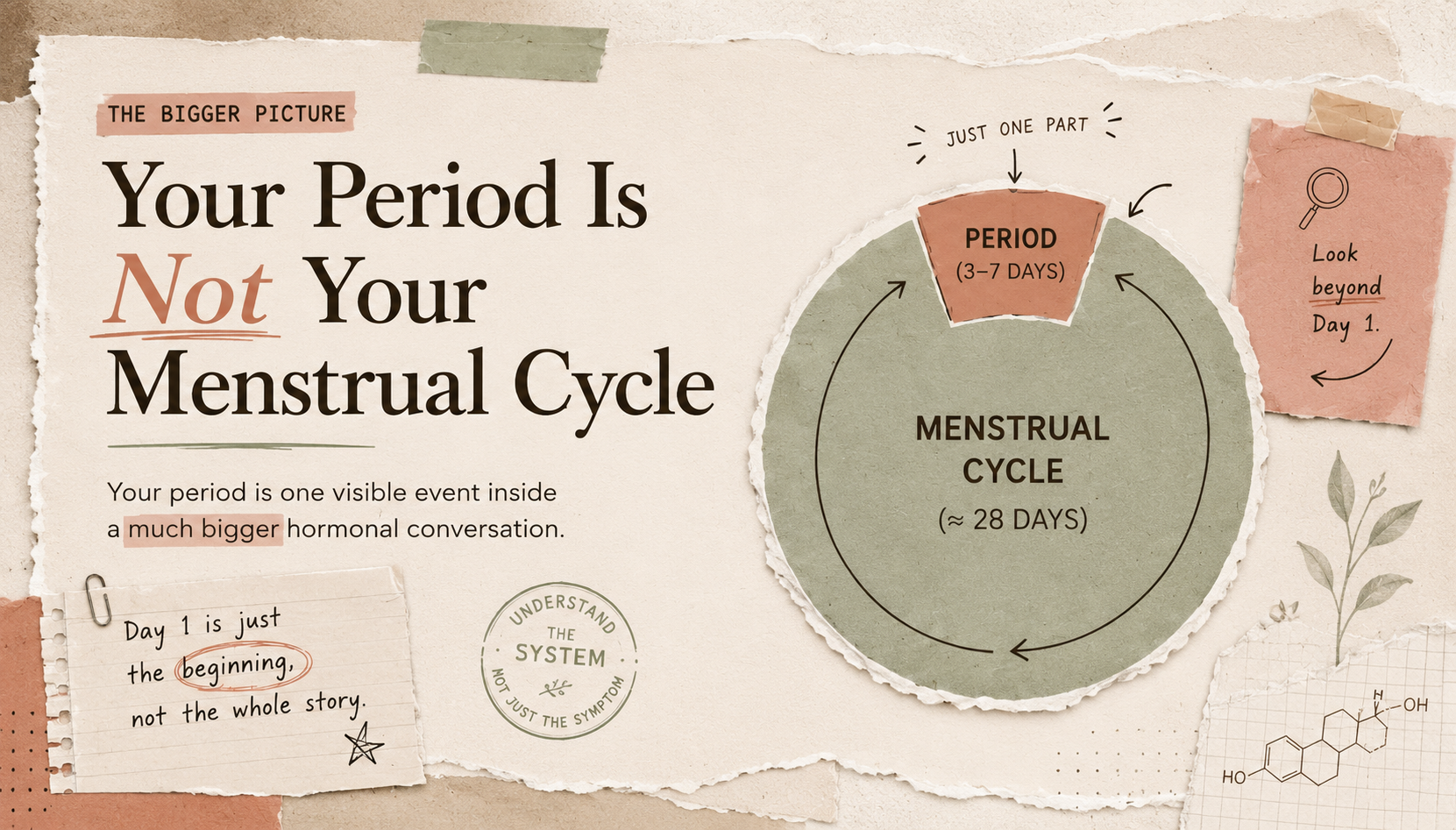
Your period is not your menstrual cycle.
It's one visible part of a much bigger conversation happening inside your body all month.
And if you're over 35 and trying to understand perimenopause, this is one of the most useful pieces of the puzzle to understand first.
Your cycle actually starts with a conversation
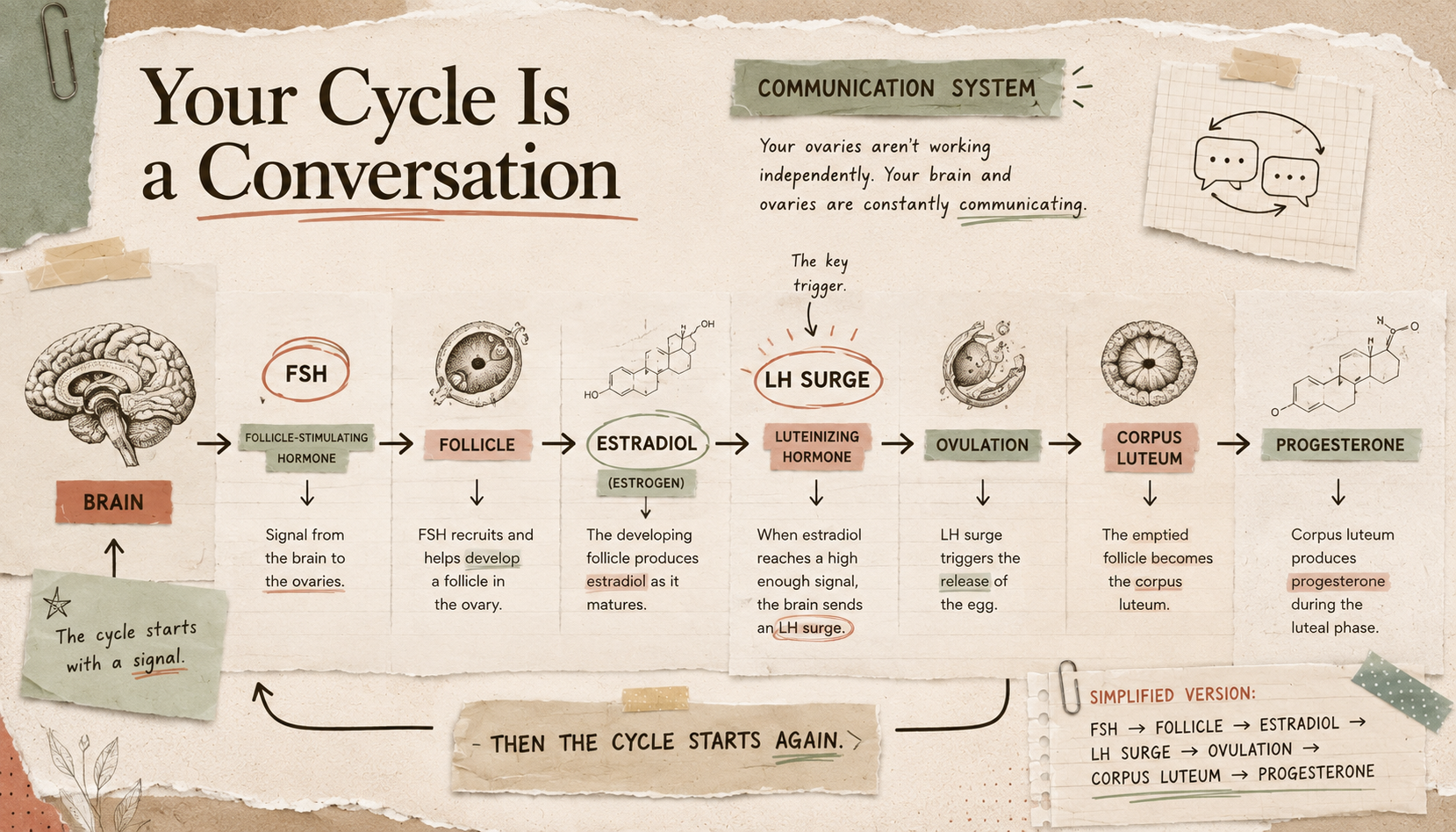
Your brain and your ovaries are constantly communicating through hormones.
One of the first signals in this process is FSH, or follicle-stimulating hormone.
FSH helps recruit and develop a follicle in your ovary. As that follicle grows, it produces estradiol, the main estrogen during the reproductive years.
Then estradiol rises.
When the signal gets high enough, it contributes to a surge of another hormone called LH, or luteinizing hormone.
And LH triggers ovulation.
After ovulation, the follicle that released the egg changes into something called the corpus luteum. That structure produces progesterone during the second half of your cycle.
So, in very simplified terms:
FSH → follicle → estradiol → LH surge → ovulation → progesterone
That is the menstrual cycle.
Your period is what you can see at the end of that process.
Suddenly, “I got my period” feels like a pretty incomplete description of what your body has actually been doing.
The first half and second half of your cycle aren't the same
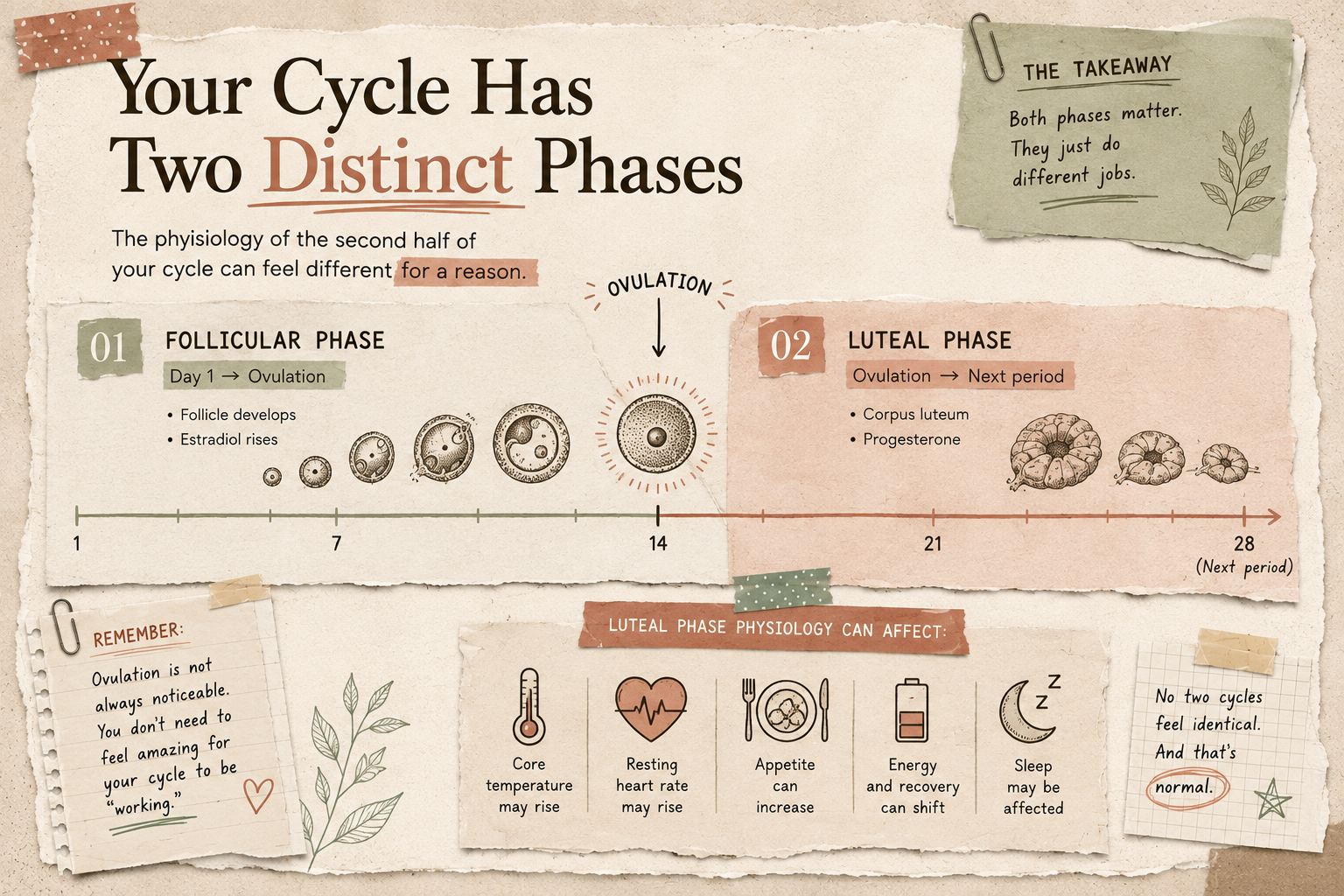
The first half is called the follicular phase. It starts on the first day of your period and continues until ovulation.
During this time, the follicle develops and estradiol rises as it gets closer to ovulation.
Then you ovulate.
After that comes the luteal phase. This is when progesterone becomes the dominant hormone and your physiology shifts.
Your body temperature can change. Your appetite can change. Your energy and recovery can feel different. Even things like resting heart rate can shift.
Which means something I think is worth remembering:
You are not necessarily supposed to feel exactly the same every day of your cycle.
Your physiology isn't static. It's moving.
And that matters when you're trying to understand how you feel.
This is where the perimenopause connection gets interesting
For most of your reproductive years, your brain and ovaries have been having this conversation in a relatively predictable pattern.
But eventually, that pattern starts to become less predictable. That's part of what happens during the transition into perimenopause.
You might think perimenopause starts when your periods become wildly irregular. But that isn't necessarily how it begins.
Your periods can still look relatively regular while the underlying hormonal pattern is becoming less predictable. One early change can be that your cycles become shorter.
You might still think: “I'm getting my period every month. Nothing has changed.”
Except maybe you don't feel quite the same.
Your sleep isn't as reliable. Your mood feels different. Your ability to handle stress doesn't feel like it used to. Your brain feels a little less cooperative.
And you're left wondering whether you're imagining it because, technically, your period is still showing up.
This is exactly why understanding the cycle matters.
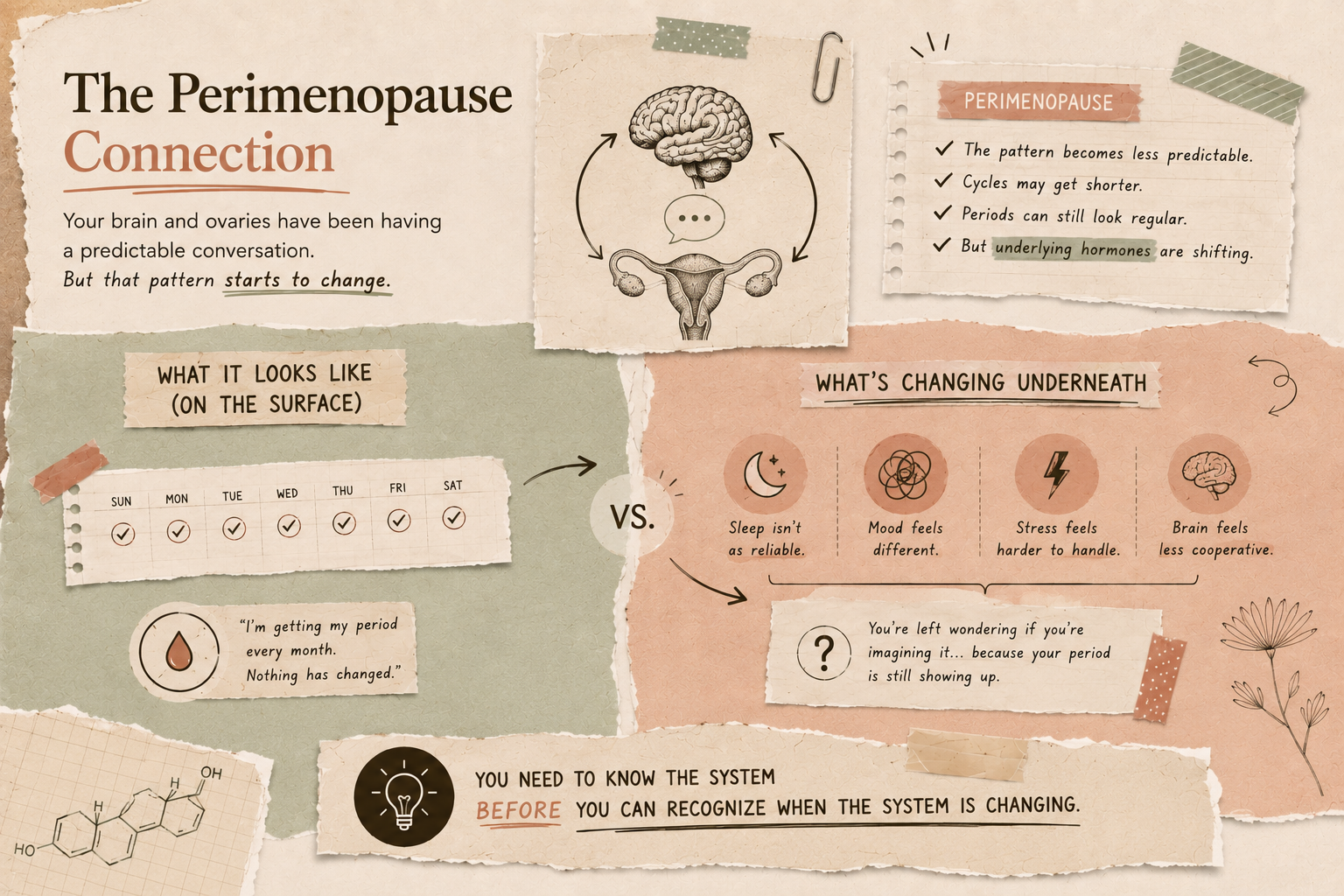
You need to know the system before you can recognize when the system is changing.
Your hormones aren't supposed to stay at one perfect number
Hormones aren't static. They rise. They fall. They pulse. They respond to signals from your brain, ovaries and environment.
So a hormone test is a snapshot of what's happening at one particular moment.
That doesn't mean testing is useless. It means one number doesn't tell the entire story.
Your cycle pattern matters. Your symptoms matter. Changes from your own baseline matter. Context matters.
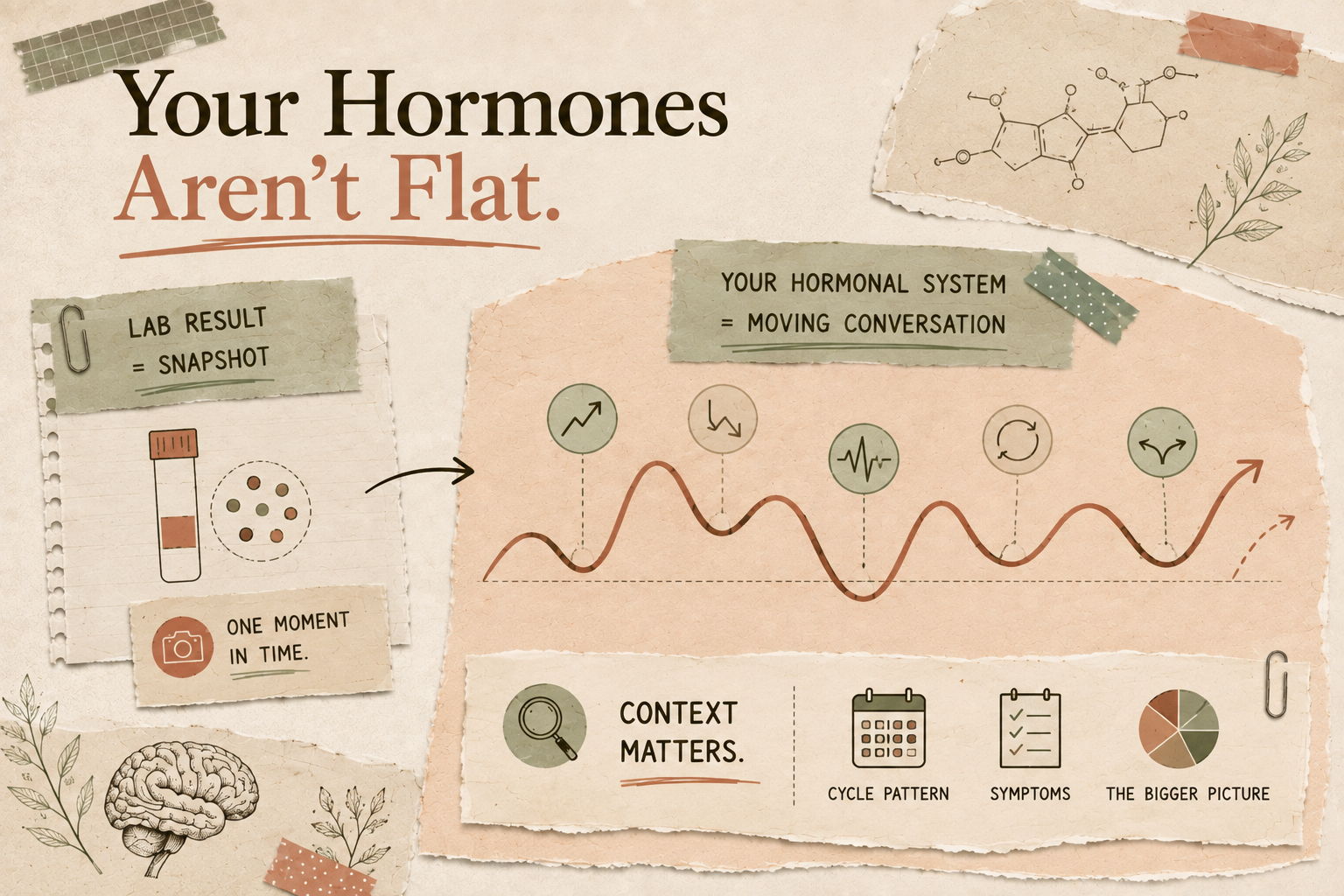
This is also why tracking your cycle can be useful during this stage of life. Not because you need to become obsessed with every little fluctuation. And not because an app can tell you exactly what your hormones are doing.
The point is much simpler:
You want to know your baseline.
Start tracking the pattern, not just the period
If you've never really paid attention beyond “when am I going to get my period?”, this is a good time to start.
Notice your usual cycle length. Notice whether that starts changing. Notice your bleeding pattern. Notice whether certain symptoms seem to show up at particular points in your cycle.
You don't need to turn this into a second job.
You need a way to actually see your own pattern over time.
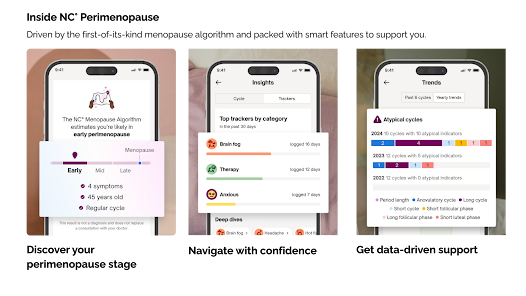
Natural Cycles can help you track and interpret cycle data. It is not a diagnostic tool for perimenopause, so significant changes or concerning symptoms are still worth discussing with a healthcare provider.
The Rise Decoded may earn a commission if you sign up through an affiliate link, at no additional cost to you.Want to understand your own pattern?
If you're starting to wonder whether the changes you're noticing could be related to perimenopause, The Rise Decoded has a free 4-minute Symptom Assessment covering 63 symptoms across 9 categories.
It isn't a diagnosis, and it isn't a substitute for talking to your healthcare provider. It's a starting point for understanding your symptoms.
Take the free Symptom Assessment →