You don't need another app.
I know.
Your phone is already carrying your calendar, grocery list, banking app, approximately 14 screenshots you forgot you took, and enough notifications to qualify as a second nervous system.
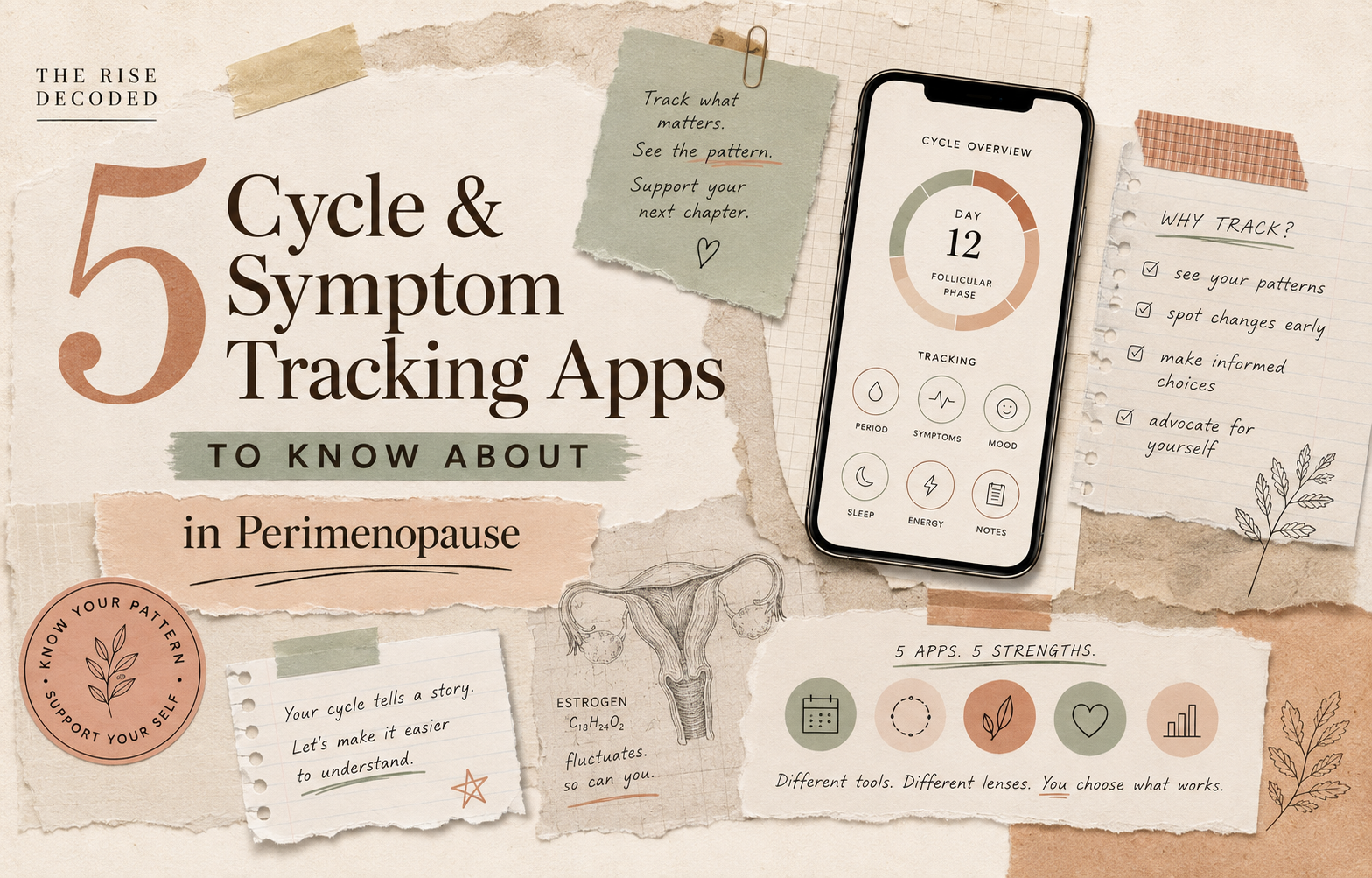
But if you're over 35 and starting to notice changes in your cycle, sleep, mood, energy or other symptoms, having a record of what's happening can actually be useful.
Because your period is only one part of your menstrual cycle.
And as you move toward perimenopause, the pattern can become more interesting than the individual period.
Your cycles may change. Symptoms can appear or shift. What used to feel predictable may become less so.
That's where tracking can help.
Not because an app can diagnose you.
It can't.
But because “I feel different” becomes much more useful when you can actually see what has changed.
So I went looking at the current cycle and perimenopause apps and pulled together five worth knowing about.
They're not all designed for exactly the same thing, so rather than declaring one “the best,” here's what each one does particularly well.
1. Natural Cycles
Best for: Understanding your personal cycle patterns
This is the one I personally think makes the most sense if your goal is to understand what your cycle is actually doing over time.
Natural Cycles uses temperature data alongside your cycle information, and its newer NC° Perimenopause mode is specifically designed for the menopausal transition.
You can track symptoms and lifestyle factors, look for patterns over time, and get insights into cycle changes. The app also offers a perimenopause stage assessment and a personalized Cycle Report that you can download for healthcare conversations.
One feature I particularly like for real life: you don't necessarily have to manually take your temperature every morning. Natural Cycles can integrate with compatible wearable devices to collect temperature data overnight.
And this matters because we're trying to build a picture of your pattern, not compare you with some imaginary woman whose cycle is exactly 28 days long every month.
Why I'd consider it
If you're interested in seeing how your cycle and symptoms change over time, this is one of the more data-driven options.
Natural Cycles is an affiliate partner of The Rise Decoded. If you sign up through my link, I may earn a commission at no additional cost to you.
2. Clue
Best for: Detailed cycle and symptom tracking
Clue is a strong option if you want to track more than when your period starts and ends.
Its current Clue Perimenopause mode was designed specifically for the transition toward menopause. You can track experiences such as hot flashes, mood changes and sleep, while also seeing how your cycles change over time.
Clue also lets you customize tracking, which can be useful when you have symptoms that aren't neatly represented by a standard period calendar.
The dedicated Perimenopause mode is currently part of Clue Plus. There are still ways to track relevant experiences using the free version, including categories such as energy, mind and feelings and a limited number of custom tags.
Why I'd consider it
“I want to see whether my sleep, mood, symptoms and cycle are changing together.”
Clue is worth looking at.
3. Flo
Best for: Cycle tracking + education + perimenopause support
Flo has been around for years as a period and cycle tracker, but its perimenopause tools have expanded significantly.
Its current perimenopause offering includes symptom tracking, personalized insights and educational content. Flo also has a Perimenopause Score, which it describes as a digital assessment tool developed and validated specifically around perimenopause symptom burden.
Another useful feature is that Flo can show a window for when your next period might arrive rather than pretending it knows the exact date when your cycles are becoming less predictable.
And Flo has been doing active research in this area. A 2026 study conducted with researchers from Mayo Clinic looked at perimenopause symptoms among more than 12,000 Flo users aged 35 and older.
Why I'd consider it
If you want one place for cycle tracking, symptoms, education and broader women's health information, Flo is a strong all-in-one option.
Some of the dedicated perimenopause features are part of Flo Premium.
4. Ovia
Best for: Connecting cycle information with broader health tracking
Ovia takes a slightly broader approach.
When you set up the app, you can choose goals that include navigating peri/menopause, and the app can personalize the experience around that goal.
You can track things like:
- cycle information
- basal body temperature
- perimenopause symptoms
- and other health indicators
The idea is that the more information you track, the more personalized your insights can become. Ovia also includes a large library of reproductive and menopause-related educational content.
Why I'd consider it
If you like having cycle information and broader health information in the same place, Ovia is worth a look.
One thing to check before choosing it: some Ovia features can depend on whether you access the app through an employer or health plan.
5. Balance
Best for: Tracking perimenopause symptoms
Balance is a little different from the others.
It isn't really trying to be your traditional period-prediction app.
It's built specifically around perimenopause and menopause.
The Balance app lets you track symptoms, moods and periods, and you can generate a personalized Health Report that can be shared with your healthcare provider. It also combines symptom tracking with educational content and a community.
That Health Report is probably the feature I'd pay the most attention to.
Because sometimes the useful information isn't:
“My period is due Thursday.”
It's:
“I've been having sleep problems 18 times this month, I've noticed these mood changes, and here's when they started.”
That's a very different conversation.
Why I'd consider it
If you're already experiencing several symptoms and want to document what's happening and prepare for a healthcare appointment, Balance is particularly interesting.
So... which one should you choose?
Honestly?
The one you'll actually use.
You don't need to download all five and turn your phone into a perimenopause command centre.
Pick the thing you're trying to understand.
If you want...
Personal cycle data + temperature tracking: Natural Cycles
Detailed cycle + symptom tracking: Clue
Cycle tracking + education + broader women's health: Flo
Cycle + broader health tracking: Ovia
Perimenopause symptoms + a report for your healthcare provider: Balance
And remember what we're actually trying to accomplish here.
Not more data for the sake of having more data.
We're trying to notice patterns.
Because when your body starts changing, your own baseline becomes incredibly useful.
One last thing before you start tracking everything
Please don't turn this into another performance metric.
You don't need perfect tracking.
You don't need to log every sensation your body produces.
And you definitely don't need to panic because your app says something is “different.”
Tracking is information.
It's not a diagnosis.
If you're experiencing new, persistent or concerning symptoms, bring that information to your healthcare provider rather than relying on an app to tell you what's happening.
Take the free 4-minute Symptom Assessment
And if you're just starting to wonder:
“Could some of the things I've been experiencing actually be related to perimenopause?”
I've got a place for you to start.
It covers 63 symptoms across 9 categories and helps you see which perimenopause-related patterns may be showing up for you.
It's not a diagnosis.
It's a starting point for understanding what you're experiencing and deciding what might be worth paying closer attention to or discussing with your healthcare provider.
Take the free Symptom Assessment →