
You've walked into a room and forgotten why you're there.
You start three things at once, finish none of them, and somehow spend twenty minutes looking for your phone while holding it.
You reread the same email. You lose the thread in a conversation. You know what needs to get done, but getting started feels weirdly difficult.
And then comes the question many women start asking in their 40s:
Is this perimenopause... or have I had ADHD this whole time?
It's a reasonable question. The frustrating part is that the answer isn't always obvious.
Perimenopause can change the way your brain feels
Cognitive symptoms are common during the menopause transition. Women often describe changes in memory, attention, word finding and mental clarity, sometimes using the shorthand brain fog.
That doesn't mean your brain is failing. It means a period of significant hormonal change can coincide with noticeable changes in how thinking feels day to day.
Sleep disruption, stress, anxiety, mood changes and the sheer cognitive load of midlife can pile onto the experience too.
So if your previously reliable brain suddenly feels less reliable, you're not imagining the experience.
And ADHD can look surprisingly similar
Adult ADHD can involve difficulty with attention, organization, working memory, task initiation, time management and emotional regulation. In women, it may go unrecognized for years because symptoms can be masked, compensated for or mistaken for personality traits.
That creates an awkward overlap with perimenopause.
Both can involve:
- forgetfulness and losing track of things
- difficulty concentrating
- trouble starting or finishing tasks
- feeling overwhelmed by ordinary demands
- difficulty switching between tasks
- emotional frustration when your brain isn't cooperating
The symptoms can look similar even when the underlying story is different.
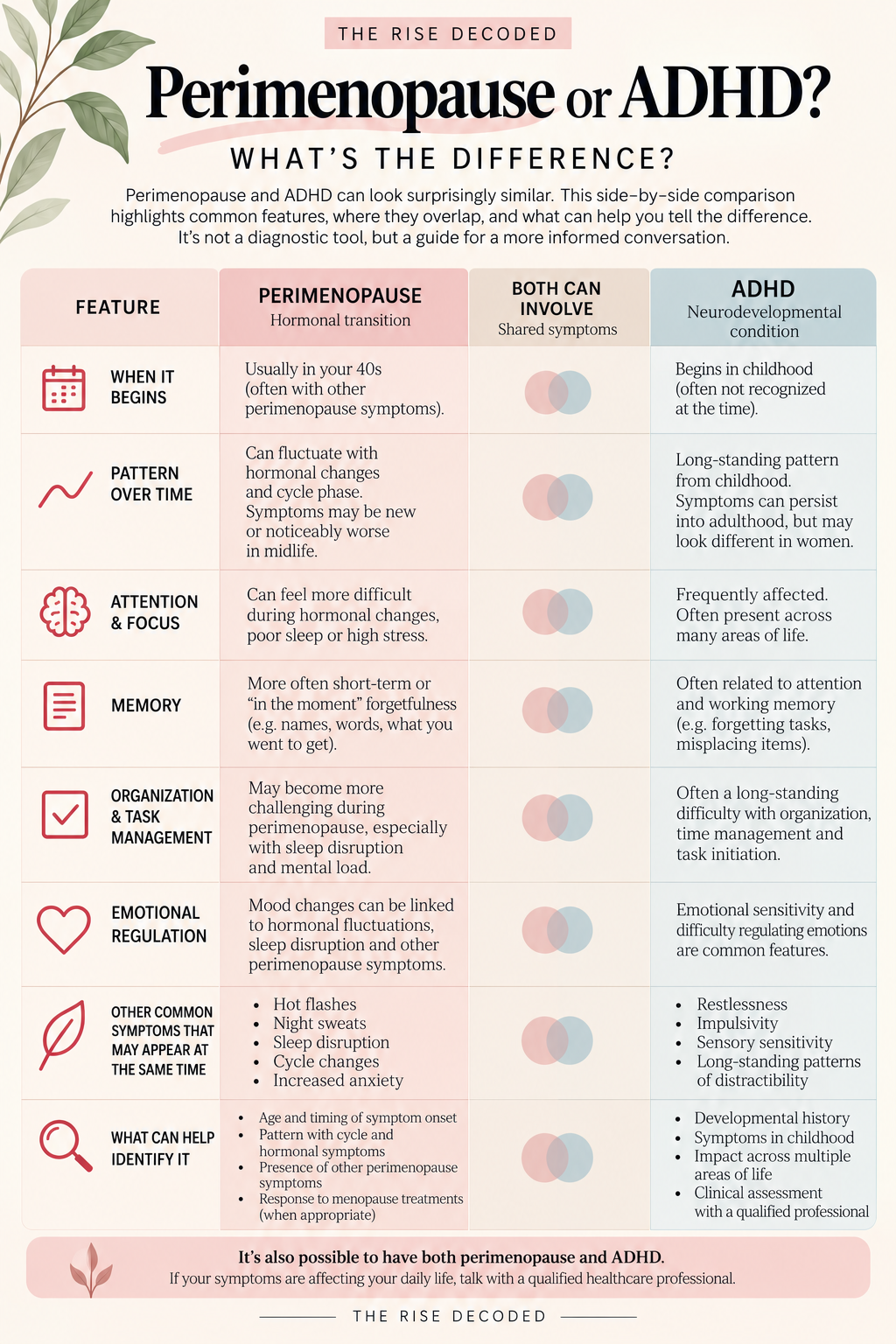
A useful starting point is to look at timing, patterns and the symptoms happening alongside the brain fog, rather than trying to label the experience from one symptom.
The biggest clue is often the timeline
ADHD is a neurodevelopmental condition. That means the pattern begins earlier in life, even if nobody recognized it as ADHD at the time.
Perimenopause-related cognitive changes, on the other hand, can feel noticeably new or different as you move through the menopause transition.
That makes your history important.
If you've always been chronically late, lost things constantly, struggled with organization, needed intense last-minute pressure to complete work, or developed elaborate systems to compensate for attention difficulties, that history is worth mentioning to a healthcare professional.
If you were generally able to manage those things and then noticed a significant change in your 40s, the timing is also meaningful.
And there is an important third possibility:
You can have ADHD and experience the cognitive effects of perimenopause.
One doesn't cancel out the other.
Why the overlap gets especially confusing in midlife
Midlife is not exactly a controlled experiment.
Sleep can deteriorate. Work can become more demanding. Parenting and caregiving can increase. Relationships change. Stress accumulates. Anxiety or depression can appear or become harder to manage.
Then add fluctuating hormones to the mix.
That means a change in concentration isn't automatically evidence of ADHD, and it isn't automatically “just hormones” either.
The goal is not to choose a label as quickly as possible. The goal is to understand the pattern well enough to decide what kind of support makes sense.
Try being a brain detective for two to four weeks
Before you decide what your symptoms mean, collect a little data.
You don't need a complicated app or a colour-coded spreadsheet that becomes its own full-time job. A few notes each day can be enough.
Track:
- Cycle timing: Where are you in your cycle, if you can tell?
- Brain symptoms: Focus, memory, word finding, task initiation, distractibility.
- Sleep: How long you slept and whether you woke during the night.
- Mood: Anxiety, irritability, low mood or unusual emotional intensity.
- Other symptoms: Hot flashes, night sweats, headaches, fatigue or anything else that seems relevant.
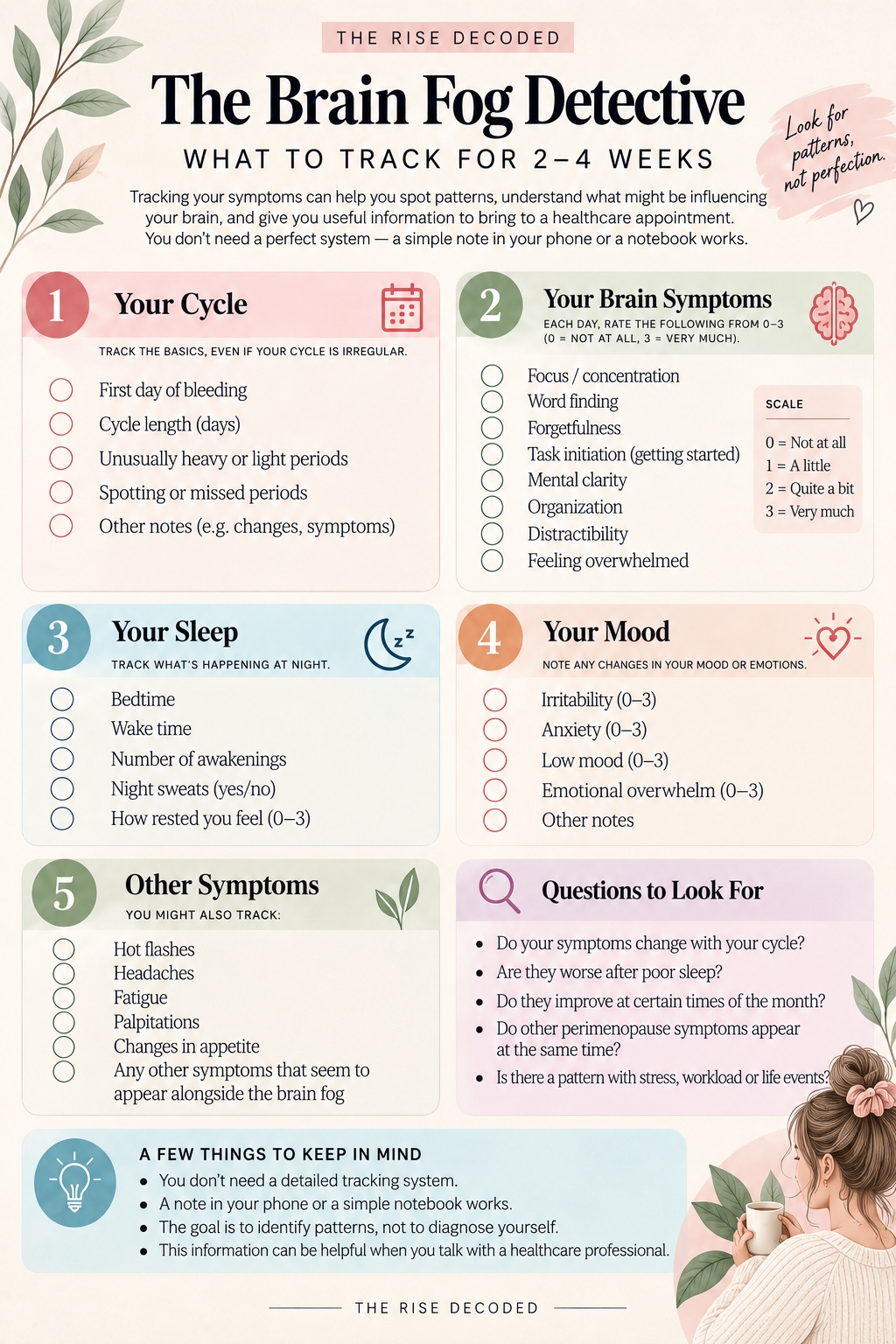
Use this as a simple visual checklist for two to four weeks. You are looking for patterns, not perfection.
After a couple of weeks, look for patterns rather than perfect explanations.
Do symptoms cluster around certain parts of your cycle? Do they get much worse after poor sleep? Are they present consistently? Did they start recently, or can you recognize versions of them from childhood and adolescence?
What your childhood history can tell you
If ADHD is part of the question, think beyond your current symptoms.
Were you often described as forgetful, dreamy, scattered, disorganized or “not living up to your potential”? Did you struggle to complete homework even when you understood the material? Did you routinely lose school supplies, miss deadlines or need enormous amounts of effort to stay organized?
None of these questions proves ADHD. They're simply useful pieces of history because adult ADHD assessment considers symptoms across development, not just what is happening this year.
When it's worth talking to a professional
Consider bringing this up with a healthcare professional if the changes are persistent, significantly affecting work or relationships, causing distress, or making everyday tasks much harder than they used to be.
A professional can help consider the wider picture, including menopause transition, ADHD, sleep problems, anxiety, depression, medications and other possible contributors.
If ADHD is suspected, an assessment can also look at your developmental history rather than relying on a current symptom checklist.
And if symptoms are sudden, severe or substantially different from your usual experience, don't assume they're hormonal. New or concerning cognitive changes deserve appropriate medical evaluation.
The takeaway
You don't have to solve the “perimenopause or ADHD?” question by yourself, and you don't need to pick a diagnosis because a social-media checklist felt familiar.
Start with the pattern.
What changed? When did it change? What was your attention and organization like before? What happens alongside the brain fog? What happens when you sleep well?
That information is much more useful than a label pulled from a single symptom.
Track the pattern. Bring the history. Then get the right help for the problem you're actually having.
A note on sources
This article is intended for education, not diagnosis. It draws on evidence and clinical guidance concerning cognitive symptoms during the menopause transition and adult ADHD, including guidance from The Menopause Society, the CDC and NICE, as well as recent research on cognition and hormonal changes in midlife.
Symptoms that overlap across conditions deserve context. If you're concerned about a change in your cognition, attention or mood, talk with a qualified healthcare professional.
If you know what is getting in the way but need help reducing the mental load, we pulled together five tools for focus, routines, accountability and task initiation.
Read: Your Brain Is Overloaded. 5 Tools That Can Help. →