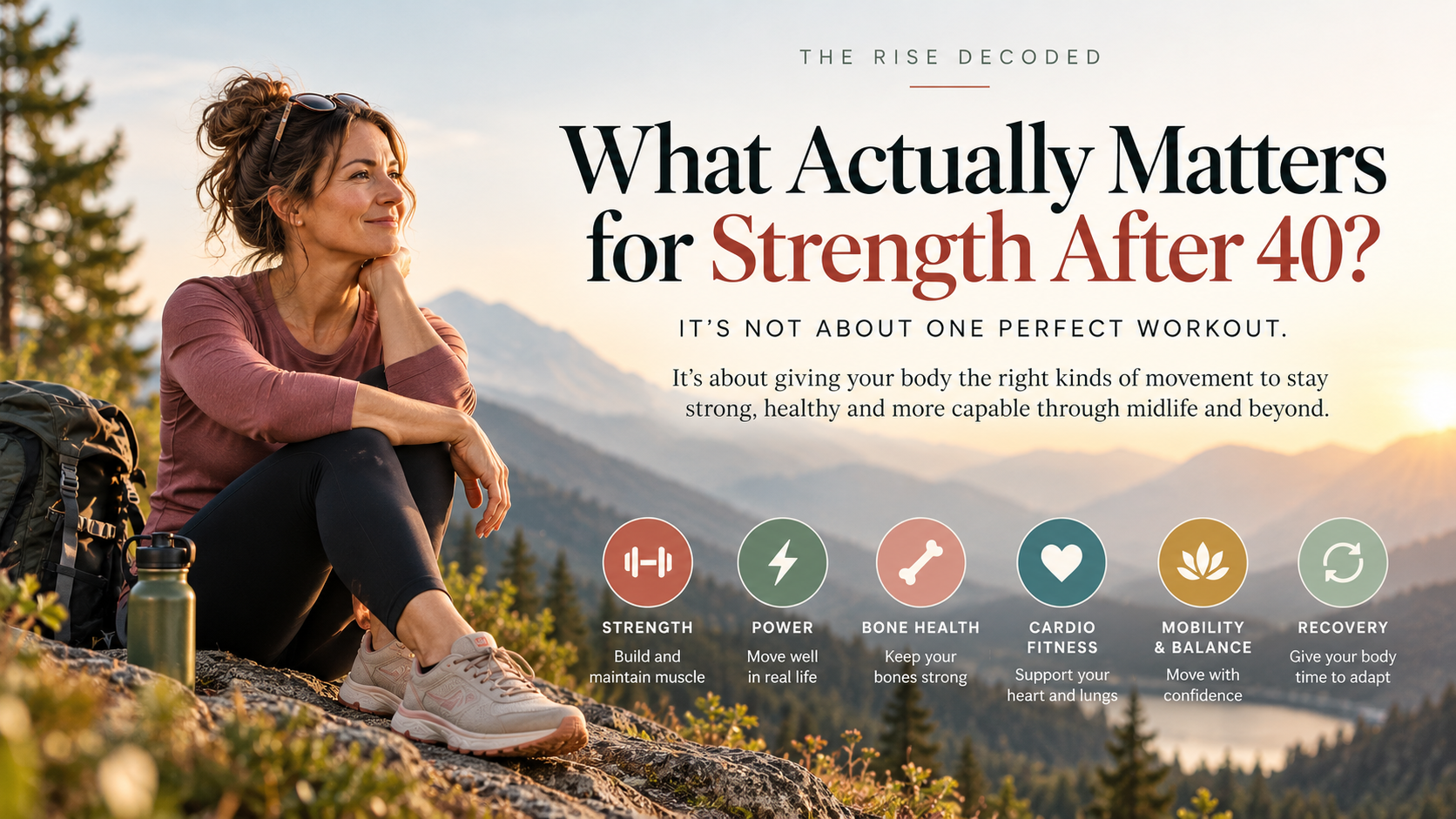
If you're already walking, running, cycling, swimming, doing Pilates, practicing yoga, taking classes, or simply trying to stay active, you may have noticed that the conversation about exercise after 40 has changed.
Suddenly, you're being told to lift heavy.
Or train for power.
Or do more cardio.
Or stop doing so much cardio.
Eat more protein.
Protect your bones.
Work on your balance.
Recover more.
It can start to sound less like a fitness plan and more like a part-time job.
But the real question isn't:
“Which exercise is best after 40?”
It's:
Does your current movement routine give your body the different types of stimulus it needs for strength, muscle, bones, cardiovascular fitness, power, balance and long-term function?
That is a much more useful question.
And the answer doesn't require throwing away the activities you already enjoy.
It requires understanding what each type of movement gives you, identifying what may be missing, and making a few strategic additions.
First: Stop Looking for the One Perfect Exercise
There is no single exercise that does everything.
Running is excellent for cardiovascular fitness and provides weight-bearing impact.
Cycling can be fantastic cardiovascular training and builds substantial lower-body endurance.
Yoga can support mobility, balance, body awareness and muscular endurance.
Pilates can develop core control, stability and muscular endurance.
Walking is accessible, weight-bearing and enormously useful for maintaining regular movement.
Swimming provides excellent cardiovascular exercise with very little joint impact.
And strength training does something these activities generally don't provide in the same way: progressively challenging your muscles against resistance.
The goal isn't to pick a winner.
It's to build a movement portfolio.
Think less:
“What workout should I do?”
And more:
“What does my body need, and where am I getting it?”
1. Resistance Training Deserves a Seat at the Table
This is probably the biggest change many women can make.
Resistance training means deliberately challenging your muscles against resistance.
- dumbbells
- barbells
- resistance bands
- machines
- cables
- kettlebells
- or your own body weight
And no, it doesn't have to mean joining a gym and becoming deeply acquainted with the squat rack.
The 2026 American College of Sports Medicine position stand emphasizes that consistency matters more than complicated programming, and that effective resistance training can be done with bodyweight, elastic bands and home-based routines.
Research specifically in postmenopausal women also supports resistance training for bone health. A 2025 meta-analysis of 17 randomized controlled trials involving 690 women found improvements in bone mineral density at the lumbar spine, femoral neck and total hip.
And a 2026 University of Calgary feasibility trial involving peri- and early postmenopausal women found that nine months of twice-weekly supervised heavy strength and impact training improved strength, lean mass, leg power and lumbar-spine bone mineral density. It was a small feasibility trial, so it is promising rather than definitive, but the findings are particularly relevant to this stage of life.
Your practical target: 2–3 resistance-training sessions per week.
For a beginner, two full-body sessions per week is an excellent place to start. A practical session can be around 20–40 minutes.
You don't need to start with three. You don't need to train every day. And you don't need a complicated split routine.
The World Health Organization recommends muscle-strengthening activities involving the major muscle groups on at least two days per week. Osteoporosis Canada similarly recommends progressive resistance training at least twice weekly.
2. Progressive Overload Is More Important Than Having a Fancy Workout
This is the part that often gets lost in the endless stream of new workout programs.
Your muscles don't particularly care whether your workout has a trendy name.
They care whether you're asking them to adapt to a challenge.
That's where progressive overload comes in.
Over time, you might:
- increase the weight
- increase resistance
- perform more repetitions
- use a more challenging variation
- improve your range of motion
- or gradually increase the amount of work you can handle
You don't need to increase everything at once. In fact, you shouldn't.
The goal is simply to avoid doing exactly the same workload forever.
Start with a resistance level that allows you to perform the exercise with good control. As you become comfortable and the same workout starts feeling noticeably easier, increase the challenge.
That's progression.
You don't need to chase exhaustion. You need to give your body a reason to adapt.
3. If You Don't Know What Exercises to Do, Start Here
This is where many women get stuck.
They've heard:
“You should strength train.”
Great.
But then they open an app, see 47 exercises involving something called a Bulgarian split squat, and quietly return to walking.
Let's make this simpler.
A beginner strength routine should generally cover the major movement patterns.
A simple full-body starting point
- Squat: chair squat, bodyweight squat or goblet squat
- Hinge: hip hinge, Romanian deadlift or dumbbell deadlift
- Push: wall push-up, incline push-up, dumbbell chest press or overhead press
- Pull: dumbbell row or resistance-band row
- Single-leg movement: step-up, supported split squat or reverse lunge
- Core/carry: dead bug, farmer carry or suitcase carry
You don't necessarily need all six every time. The point is to make sure your training isn't just 30 minutes of squats because squats are the only exercise you remember.
A free way to get started
If you're completely new to strength training and don't know how to structure a workout, Nike Training Club is a very reasonable place to start.
Nike's Canadian app currently offers 200+ free workouts and targeted training programs, including bodyweight workouts and sessions with and without equipment. Workouts range from approximately 5–50 minutes and are led by Nike trainers.
Start with Nike Training Club →
Look for Beginner → Full Body → Strength.
Weeks 1–2: 2 full-body strength sessions per week, 20–30 minutes, bodyweight or light resistance. Concentrate on learning the movements.
Weeks 3–4: 2 sessions per week, 25–40 minutes. Introduce dumbbells or more resistance if appropriate.
Weeks 5–8: Continue 2–3 sessions per week. Gradually increase resistance or difficulty and keep track of weights or repetitions.
The goal isn't to find the hardest workout. It's to create a routine you can actually repeat.
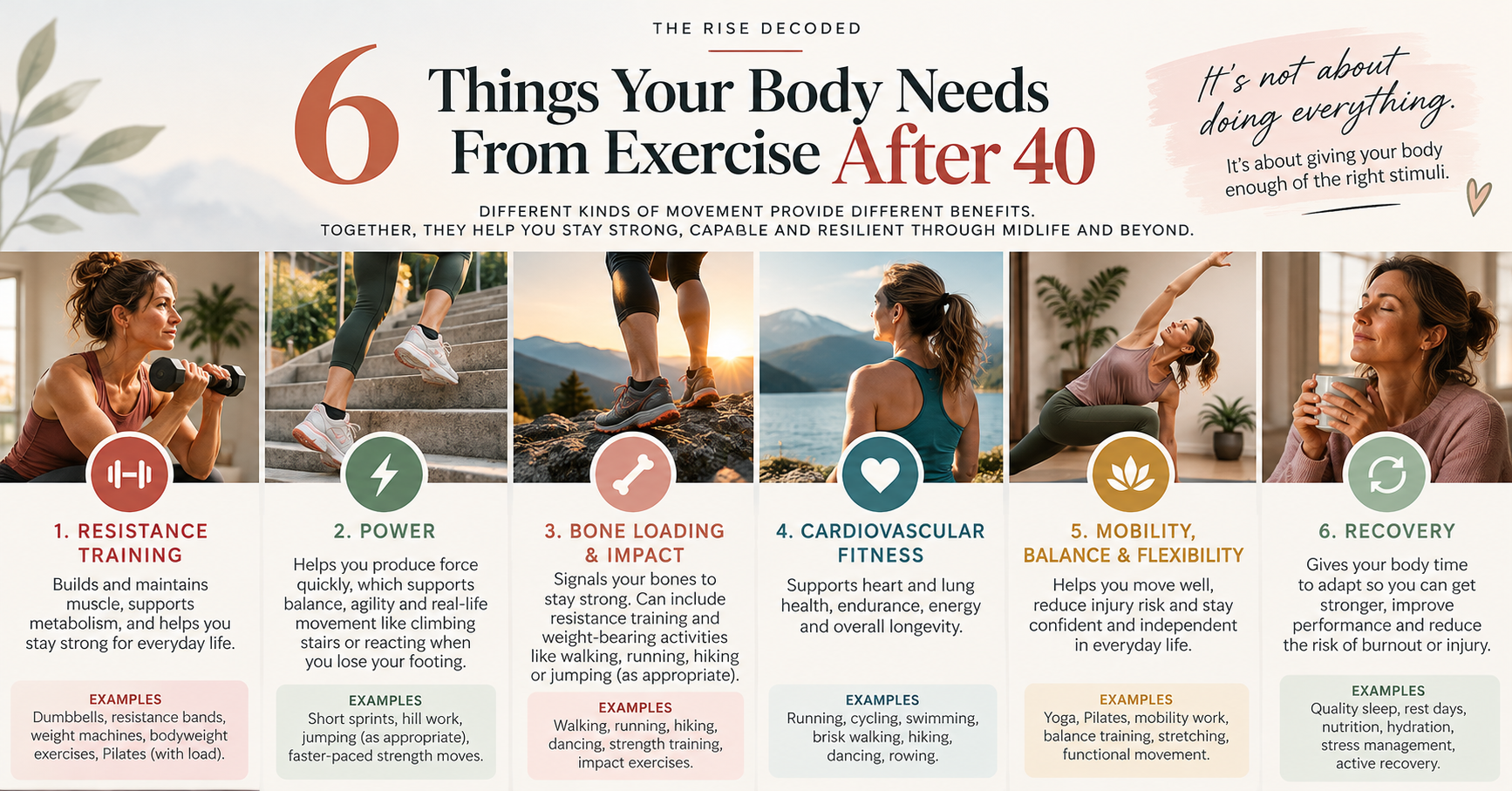
Different kinds of movement provide different benefits. Together, they form a more complete midlife movement routine.
4. Strength and Power Are Not the Same Thing
This distinction matters more than most fitness advice suggests.
Strength is your ability to produce force.
Power is your ability to produce force quickly.
For example: being able to lift a heavy box is strength. Being able to quickly step over something, catch yourself when you trip, or get up from the floor with control involves power and functional movement.
Power tends to decline with age, and Dr. Stacy Sims specifically advocates including power-focused work alongside strength training for women during and after the menopausal transition.
ACSM's 2026 position stand describes power training as using moderate loads and moving them quickly during the lifting phase.
Does that mean you need to start doing box jumps tomorrow?
No.
Power training can be progressed. For someone new to exercise, simply developing strength, balance and confidence may come first.
Later, appropriately selected movements such as faster controlled sit-to-stands, step-ups, medicine-ball movements, small hops, jumps or other explosive exercises may be appropriate depending on fitness, goals and health.
If impact exercise isn't appropriate for you, don't force it.
5. Bone Health Requires More Than “I Exercise”
This is one of the most important distinctions in midlife.
Some activities are excellent for your cardiovascular system but provide relatively little bone-loading stimulus.
Cycling and swimming are good examples.
Walking is weight-bearing, but the bone stimulus can be different from higher-impact activity.
Resistance training matters here too because muscles pulling against bones create mechanical loading.
What counts as bone-loading activity?
Weight-bearing movement: walking, hiking, stairs, dancing, jogging and running.
Resistance training: squats, deadlifts, presses, rows and loaded carries.
Higher-impact activity: jumping, hopping, jogging/running, some sports and certain dance activities.
The Bone Health & Osteoporosis Foundation identifies walking, jogging, dancing, stair climbing and similar activities as weight-bearing exercise, while also noting that high-impact exercise may not be appropriate for everyone. Osteoporosis Canada recommends progressive resistance and balance/functional training as part of fracture prevention.
The 2026 STOP-EM trial is particularly interesting because its intervention combined heavy resistance training with impact training twice per week and produced improvements in lumbar-spine bone mineral density along with muscle and power outcomes. Again, this was a small feasibility trial, not a universal prescription.
If you're considering high-impact exercise specifically for bone health, your starting point should depend on your current fitness, bone health and injury risk.
More impact isn't automatically better.
If you have osteoporosis, a history of fragility fractures, significant joint problems or another condition that could affect exercise safety, get individualized guidance from a qualified healthcare professional before adding high-impact training.
6. You Don't Have to Lift Extremely Heavy to Make Strength Training Worthwhile
This deserves its own section because “lift heavy” has become one of the loudest pieces of menopause fitness advice.
And there is an important nuance.
Heavier resistance can be extremely useful for developing strength, and experts such as Stacy Sims strongly advocate progressively heavy resistance for women during the menopausal transition.
But heavy is not a magic number that determines whether your workout counts.
ACSM's 2026 position stand emphasizes that different resistance-training approaches can produce meaningful benefits and that the appropriate load depends on the goal. For strength specifically, it points toward heavier loads, while other goals can be achieved with different loading strategies. It also notes that bodyweight and elastic-band training can be effective.
So if you've never lifted weights before, your first workout doesn't need to involve loading a barbell until your internal organs file a complaint.
Start where you are. Learn the movement. Build confidence. Then progressively increase the challenge.
7. Protein Matters, But It Isn't a Replacement for Training
Protein gets a lot of attention in the midlife conversation, and for good reason.
Adequate protein provides the amino acids your body needs to build and maintain muscle.
But protein doesn't replace the training stimulus.
Think of it this way:
Resistance training says: “Build and maintain this muscle.”
Protein provides some of the raw materials.
You need both parts of the equation.
Rather than turning this article into another argument about whether every woman needs exactly 100, 120 or 150 grams of protein, we're going to make this more useful.
Use The Rise Decoded Protein Calculator to estimate a personalized starting target based on your body and activity.
Then consider how you're distributing protein throughout the day rather than obsessing over one giant protein-heavy dinner.
8. Cardio Still Matters
This is where the “strength after 40” conversation can go off the rails.
You do not need to abandon cardiovascular exercise because you're entering midlife.
Your heart is still there. It would like to participate.
Regular aerobic activity supports cardiovascular fitness and overall health, and the WHO recommends that adults accumulate:
or
75–150 minutes of vigorous-intensity activity
or an equivalent combination.
For most people, 150 minutes of moderate activity per week is a sensible starting target.
That could look like:
- 30 minutes × 5 days
- 50 minutes × 3 days
- or shorter sessions accumulated throughout the week
You can build toward 300 minutes if you enjoy it and it fits your life. But you don't need to reach 300 minutes before your exercise “counts.”
And if you're currently doing very little activity, start smaller and build gradually.
What about running?
Keep running if you love running.
Cycling?
Keep cycling.
Swimming?
Keep swimming.
Walking?
Keep walking.
The question is not:
“Should I stop doing cardio?”
It's:
“Does my current cardio routine need strength training added to it?”
For many women, the answer is yes.
9. Balance and Mobility Are Part of the Picture Too
Strength isn't just about how much weight you can lift.
You also want to be able to:
- get up from the floor
- climb stairs
- carry groceries
- reach overhead
- turn and change direction
- maintain balance
- move through a comfortable range of motion
Osteoporosis Canada recommends balance and functional training more than twice per week, alongside progressive resistance training.
The good news is that you don't necessarily need another separate workout.
You can layer this into what you're already doing.
Your balance work might come from yoga, Pilates, single-leg exercises, step-ups, controlled strength movements or balance drills.
Mobility can come from your warm-up, cool-down, yoga, Pilates, dedicated mobility sessions or simply moving through a useful range of motion during strength exercises.
This is another reason not to throw away activities you already enjoy.
They may be filling an important part of your movement portfolio.
10. Recovery Is Part of the Training Plan
This one is easy to ignore because recovery doesn't look particularly impressive on Instagram.
But your body needs time to adapt.
If you suddenly go from almost no resistance training to five hard workouts a week, the problem isn't that you're insufficiently motivated.
The problem is that you've skipped the adaptation part.
You don't need a perfect recovery protocol.
You need to avoid making every workout a hard workout.
- space challenging strength sessions
- allow easier movement days
- get enough sleep
- eat adequately
- pay attention to persistent soreness or unusual fatigue
- adjust your training when your body clearly isn't recovering
Stacy Sims' current framework for active women emphasizes two to three progressive resistance sessions per week and filling the rest of the week with movement you enjoy rather than turning every day into another hard training session.
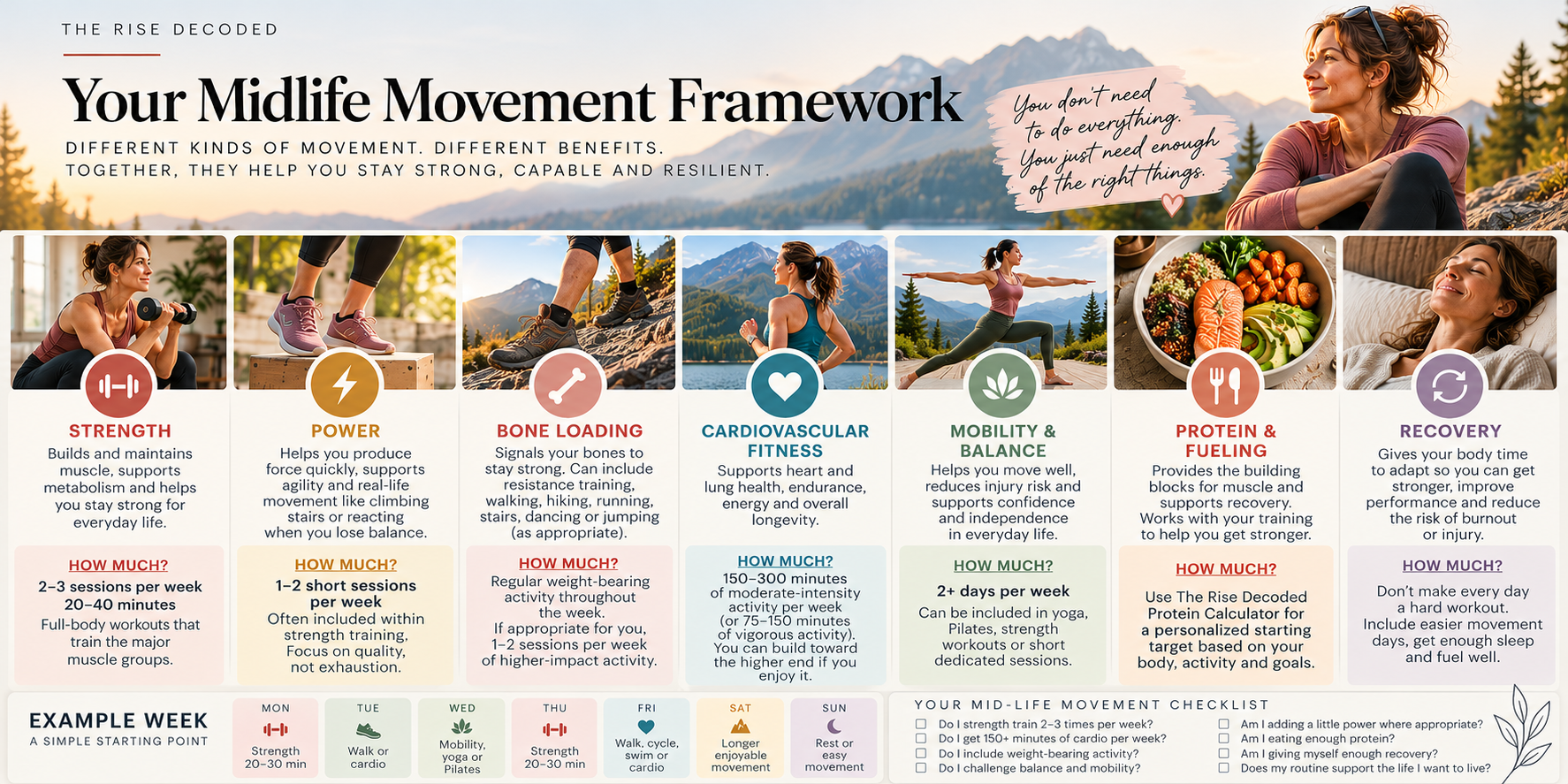
A simple movement framework: you don't need to do everything. You need enough of the right things, consistently.
So What Should Your Week Actually Look Like?
This is the part I want you to save.
You don't need to copy someone else's exact workout schedule. But a well-rounded week could look something like this:
| What your body needs | Practical target |
|---|---|
| Strength | 2–3 resistance sessions/week |
| Cardio | 150–300 min moderate OR 75–150 min vigorous/week |
| Bone loading | Regular weight-bearing + resistance activity |
| Power | 1–2 short exposures/week if appropriate |
| Balance | 2+ days/week |
| Mobility | Regularly, often layered into other sessions |
| Protein | Use the TRD Protein Calculator for a personalized starting target |
| Recovery | Easier days + adequate sleep and fueling |
These aren't eight new obligations.
That's important.
One activity can check several boxes.
A strength session can provide resistance, bone loading, balance and functional movement.
A brisk walk can provide cardiovascular and weight-bearing activity.
Yoga can contribute mobility and balance.
Running can contribute cardiovascular fitness, weight-bearing and some impact.
The goal is to layer the pieces together, not collect workouts like Pokémon.
What If You're Already Active?
This is where the answer becomes much more interesting.
Because the question isn't simply “What is the best exercise after 40?”
It's:
“If I love the exercise I'm already doing, what might I be missing?”
If you run
Running gives you cardiovascular fitness, weight-bearing activity, impact and lower-body muscular demand.
You may want to add progressive resistance training, upper-body strength, targeted lower-body strength, power work where appropriate, and adequate fueling and recovery.
You don't need to stop running. You may simply need to stop expecting running to do every job.
If you cycle
Cycling gives you cardiovascular fitness, endurance and substantial lower-body muscular work.
But cycling is not weight-bearing in the same way as walking or running.
You may want to add progressive resistance training, upper-body strength, weight-bearing activity and balance/functional work.
If you do Pilates
Pilates can provide core control, muscular endurance, balance, body awareness and mobility.
But the amount of progressive loading varies substantially between Pilates formats.
You may want to add progressive resistance training, heavier loading where appropriate, and bone-loading activity.
Pilates doesn't need to disappear. It may simply need a partner.
If you do yoga
Yoga can provide mobility, balance, body awareness, flexibility and some muscular strength and endurance.
But not every yoga practice provides the progressive resistance stimulus needed to maximize strength.
You may want to add progressive resistance training and additional bone-loading activity where appropriate.
Again, you don't need to choose.
Yoga + strength can be a very different proposition from yoga instead of strength.
If you mostly walk
Walking gives you cardiovascular activity, weight-bearing movement, accessibility and consistency.
You may want to add progressive resistance training, more intensity when appropriate, and balance/functional work.
Walking is not the problem. Walking plus nothing else may simply leave a few boxes unchecked.
The Beginner's “I Don't Know Where to Start” Plan
If you've read this entire article and your biggest thought is:
“Fine. But I still don't know what to do Monday.”
Here's your answer.
- Monday: 20–30 minute beginner full-body strength workout. Use a free beginner workout from Nike Training Club if you want someone to demonstrate the movements.
- Tuesday: Walk or other enjoyable moderate activity.
- Wednesday: Easy movement, mobility, yoga or Pilates.
- Thursday: 20–30 minute beginner full-body strength workout.
- Friday: Walk, cycle, swim or another cardio activity.
- Saturday: Longer enjoyable movement. Walk, hike, dance, cycle. Whatever you actually enjoy.
- Sunday: Rest or easy movement.
That's it.
As you become stronger and more comfortable, the strength sessions can become longer or more challenging.
If you're already doing a lot of cardio, you don't need to suddenly cram this entire schedule into your life. Simply identify the missing piece and add it gradually.
Your Midlife Movement Check
Before changing your routine, ask:
- Strength: Am I progressively challenging my major muscle groups at least twice a week?
- Power: Am I maintaining my ability to produce force quickly, where appropriate for me?
- Bones: Does my routine include resistance and appropriate weight-bearing activity?
- Cardio: Am I getting roughly 150 minutes of moderate activity or the equivalent each week?
- Balance: Am I deliberately working on balance and functional movement?
- Mobility: Can I move through the ranges of motion I need for everyday life?
- Protein: Am I eating enough protein to support my training and muscle maintenance?
- Recovery: Am I giving my body enough time, food and sleep to adapt?
If you can answer “yes” to most of these, you're probably much closer to a well-rounded routine than you think.
What to Do Next Week
- Put two strength sessions on your calendar. Treat them like appointments.
- Choose beginner-friendly full-body workouts. If you don't know what exercises to do, use a free guided app such as Nike Training Club.
- Keep the activity you already love. Running, cycling, yoga, Pilates, swimming, walking and dancing are not failures because they don't do everything.
- Make sure your week includes regular weight-bearing movement. Especially if your main activity is cycling or swimming.
- Gradually make your strength training harder. More resistance, more repetitions, a harder variation or better control. Not all at once.
- Check your protein intake. Use the Rise Decoded Protein Calculator rather than guessing.
- Don't make every workout hard. Your body needs the stimulus. It also needs the opportunity to respond to it.
The Bottom Line
The goal after 40 isn't to exercise more simply because you're getting older.
It's to train more intentionally.
You don't need to abandon running for lifting.
You don't need to stop doing Pilates because someone on Instagram told you it isn't enough.
You don't need to turn every workout into an extreme challenge.
And you don't need to become an expert in exercise physiology before you begin.
What matters is building a routine that gives your body the major pieces it needs:
Resistance.
Progression.
Power.
Bone loading.
Cardiovascular fitness.
Balance and mobility.
Protein and recovery.
And perhaps most importantly:
Consistency.
The best program isn't the one that looks impressive on paper.
It's the one you can still see yourself doing six months from now.
What's Next?
If you're already doing a specific type of exercise, the answer gets more interesting.
Because the question isn't simply “What is the best exercise after 40?”
It's:
“If I love the exercise I'm already doing, what might I be missing?”
Next, we'll look at that question activity by activity:
- You Run. Is Running Enough After 40?
- You Love Pilates. Is Pilates Enough for Strength After 40?
- You Love Yoga. What Does Your Body Need Beyond Yoga?
- You Cycle. What Should You Add for Strength and Bone Health?
The goal isn't to replace the movement you love.
It's to make your movement routine work harder for you.
World Health Organization. Physical activity. Recommendations for adults include 150–300 minutes of moderate-intensity aerobic activity or 75–150 minutes of vigorous activity per week, plus muscle-strengthening activity on at least 2 days per week.
Osteoporosis Canada. Clinical Practice Guideline Executive Summary. Recommendations include progressive resistance training at least twice weekly and balance/functional training more than twice weekly.
American College of Sports Medicine. Resistance Training for Health and 2026 resistance-training position stand. Guidance emphasizes progressive resistance, goal-specific loading and consistency.
University of Calgary STOP-EM trial, 2026. Nine months of twice-weekly supervised heavy strength plus impact training in peri- and early postmenopausal women improved strength, lean mass, leg power and lumbar-spine bone mineral density. This was a small feasibility trial.
2025 meta-analysis of resistance training and bone mineral density in postmenopausal women. Seventeen randomized controlled trials involving 690 women found significant improvements at several skeletal sites.
Stacy Sims. Guidance on resistance training, power and training during the menopausal transition.
Bone Health & Osteoporosis Foundation. Guidance on weight-bearing exercise and when high-impact activity may not be appropriate.
This article is educational and is not a substitute for individualized medical or exercise advice. If you have osteoporosis, a history of fragility fractures, significant joint problems or another condition affecting exercise safety, seek individualized guidance before beginning or substantially changing a training program.